Our beauty therapists answer the most frequently asked questions about Spray Tans — including how they work, safety, preparation, aftercare, how long they last, and more.
What is a spray tan?
A spray tan is a sunless tan applied as a fine mist of tanning solution, which darkens the outer layer of your skin for about a week without any UV exposure.
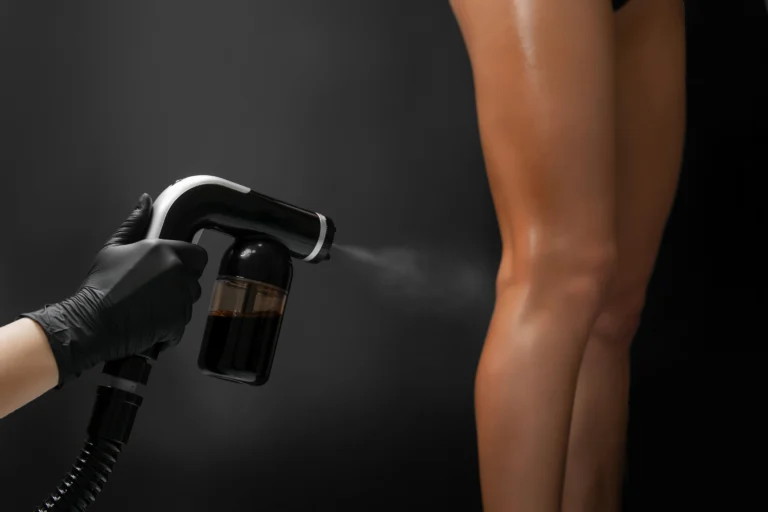
From a professional beauty perspective, a spray tan is the salon version of fake tan: depending on the salon, a beauty therapist applies it with a hand-held spray gun, or a spray booth mists you evenly.
Most spray tan solutions contain:
- Dihydroxyacetone (DHA): the active tanning ingredient, which develops the colour over several hours.
- A temporary bronzer: a guide colour that shows where the solution has gone and rinses off in your first shower.
- Skin-conditioning ingredients: many professional solutions add moisturisers, vitamins or hyaluronic acid.
How does spray tanning work?
Spray tanning works through a reaction between DHA and the amino acids in the outermost layer of your skin, which forms brown pigments called melanoidins.
This browning process is known as the Maillard reaction. It doesn’t use or trigger your skin’s own melanin, which is why a spray tan needs no sun.
The process involves:
- The solution settling on the surface of your skin
- Colour starting to appear within 1–4 hours
- The tan deepening over the next 24 hours
- The colour fading as your outer skin cells naturally shed
Because DHA only colours the surface, a spray tan is temporary and fades gradually.
What are the benefits of a spray tan?
The main benefits of a spray tan are a natural-looking tan without UV damage, even colour, and a shade matched to your skin.
Spray tan benefits include:
- No UV exposure: the colour comes from DHA, not from sunlight or sunbeds.
- Even, streak-free colour: a professional application reaches areas that are hard to tan yourself, like your back.
- A shade matched to you: your therapist chooses a solution depth to suit your skin tone and the look you want.
- Fast results: the appointment is quick, and the colour develops within a day.
- Colour that lasts about a week: a spray tan stays for days, not hours like a wash-off bronzer.
- A year-round glow: you can tan in winter or before a holiday, whatever the weather.
- Event-ready confidence: many people book one before a wedding, formal or holiday.
- Hydrating ingredients: some professional solutions include moisturisers and hyaluronic acid.
Sunbed UV damages skin over time, and it’s one reason tanning beds cause melasma to darken in people prone to pigmentation. A spray tan gives you the colour without the UV.
Is spray tanning safe?
Yes. A professional spray tan is considered safe for the skin, because DHA only colours the outermost layer and no UV is involved.
The main caution is breathing in the mist or getting it in your eyes, lips or nose. DHA is approved for use on the outside of the body, but all-over spraying hasn’t been approved by the US Food and Drug Administration, because no safety data has been submitted for those exposures.
So ask your therapist about:
- Protecting your eyes, or keeping them closed during spraying
- Lip balm, and covering your nose or using nose plugs
- A well-ventilated tanning room
Does a spray tan cause cancer? A spray tan doesn’t carry the UV-related skin cancer risk of sunbeds, and there’s no evidence that it causes cancer, although long-term research on breathing in the spray is still limited.
What are the side effects of a spray tan?
The most common side effects of a spray tan are dry skin, mild irritation and a distinctive smell while the colour develops.
Temporary side effects may include:
- Dryness, especially on areas that are already dry
- Mild itching or irritation
- A distinctive smell while the tan develops
- Patchy or uneven fading
- Colour transferring onto clothes, towels and bedding
Allergic reactions to DHA, fragrance or preservatives are less common and usually show up as a rash. With spray application, some people have reported rashes, coughing or dizziness.
If a rash, swelling or breathing problems develop, rinse off and contact your doctor.
Who should avoid a spray tan?
A spray tan may not be suitable if you:
- Have broken, sunburnt or freshly irritated skin
- Have an active eczema, psoriasis or rosacea flare in the area
- Have reacted to fake tan, fragrance or other skincare ingredients before
- Have asthma or another lung condition (ask about a self-tan lotion instead of a spray)
- Are pregnant or breastfeeding (see the next answer)
Tell your therapist about any skin conditions, allergies or medications before your tan, and ask whether a patch test is available if your skin is sensitive.
Because every skin journey is unique, a personalised consultation helps determine whether this treatment is the right fit for you.
Can you get a spray tan while pregnant?
Spray tans haven’t been studied in pregnancy, so ask your doctor or midwife before booking one.
Laboratory models suggest less than 1% of DHA is absorbed through the skin, according to the pregnancy information service MotherToBaby. Spraying can raise that, because you may breathe in some of the mist, and there are no studies on spray tans and pregnancy outcomes.
The cautious options are to wait until after your pregnancy, or to use a self-tan lotion at home, which is easier to keep away from your face. Pregnancy hormones can also make skin more reactive, even to products you’ve used before.
Can you get a spray tan while breastfeeding? Only very small amounts of DHA are expected to reach breast milk, but avoid the breast area and let the tan dry fully before your baby touches your skin.
To be safe, check with your doctor or midwife before booking.
Does a spray tan protect you from the sun?
No. A spray tan doesn’t protect your skin from the sun, even though it makes you look tanned.
DHA-tanned skin has a sun protection factor of about 3, and only for a short time. Fake tans that contain SPF only protect for a couple of hours after you apply them, not for as long as the tan lasts.
The importance of sun protection doesn’t change with a tan: use a broad-spectrum SPF 30 or higher every day, and reapply it every 2 hours outdoors.
Does a spray tan prevent sunburn? No. You can still burn under a spray tan, so cover up and use sunscreen as you normally would.
How should you prepare for a spray tan?
To prepare for a spray tan, exfoliate and shave or wax beforehand, then arrive with clean skin and no lotion, deodorant, perfume or makeup. Your therapist will give you the exact timings for your appointment.
Before your appointment:
- Exfoliate the day before, focusing on your elbows, knees and ankles
- Shave or wax at least 24 hours before
- Book any other skin treatments before your tan, not after
On the day:
- Shower without body oils or heavy moisturisers
- Skip deodorant, perfume and makeup
- Remove your jewellery
- Wear loose, dark clothing and slip-on shoes
A gentle body scrub suits most people, but if your skin is dry or sensitive, it helps to exfoliate according to skin type.
Should you shave before a spray tan? Yes. Shave at least 24 hours before, because shaving also exfoliates the skin, and the wait gives your skin time to calm down.
What happens during a spray tan appointment?
A spray tan appointment follows five steps: a consultation, skin preparation, protection, application and drying.
Here’s what each step involves:
- Consultation: your therapist checks your skin and helps you choose a shade.
- Skin preparation: a barrier cream may go on your hands, feet, nails and very dry areas, so they don’t take on too much colour.
- Protection: your hair is tied back, and your eyes, lips and nose should be protected.
- Application: the solution is sprayed on in sections, either by a therapist with a spray gun or in a booth.
- Drying: you wait until your skin is touch-dry before getting dressed.
What should you wear to a spray tan? Wear loose, dark clothes you don’t mind staining. Many salons provide disposable underwear, or you can wear your own dark underwear or swimwear, but tan lines will follow whatever you wear.
For your first spray tan, start with a lighter shade, then go deeper next time once you know how your skin takes the colour.
How long after a spray tan can you shower?
How long you wait to shower after a spray tan depends on the solution: about 1–5 hours for an express solution, or 6–12 hours for a classic one. Your therapist will tell you when to rinse yours.
Some express solutions can be rinsed after just 1–3 hours, depending on how deep you want the colour.
For your first rinse:
- Use lukewarm water only, with no soap or scrub
- Expect the water to run brown as the bronzer washes off
- Pat your skin dry gently
How long does a spray tan take to develop? A spray tan keeps deepening for around 24 hours after application, so it usually looks its deepest on day two.
What should you do after a spray tan?
After a spray tan, keep your skin dry and loosely covered until your first rinse, then moisturise daily and treat your skin gently so the colour fades evenly.
Until your first rinse:
- Avoid exercise, sweating, swimming and rain
- Wear loose, dark clothing and avoid tight straps
- Skip deodorant
- Avoid resting skin against skin, such as sitting with your legs crossed
Ongoing care:
- Moisturise every day with an oil-free lotion
- Pat dry after showering rather than rubbing
- Avoid scrubs, AHAs and retinol on tanned areas
- Keep showers short and lukewarm
- Limit time in pools, spas and saunas
- Shave gently with a sharp razor
How long does a spray tan last?
A spray tan usually lasts 5–10 days, fading gradually as your skin naturally sheds its outer cells.
How long it lasts depends on:
- The shade, as lighter shades fade sooner
- How well you moisturise and care for your skin
- Sweating, swimming and long hot showers
- Friction on areas like your hands, feet and inner thighs
How can you make a spray tan last longer? Moisturise every day, pat dry after showering, and skip exfoliating until you’re ready for the tan to fade.
How often should you get a spray tan?
Because a spray tan lasts 5–10 days, a top-up every 1–2 weeks keeps your colour consistent. Exfoliate away what’s left of your old tan first, so the new one goes on evenly.
Can you get a spray tan twice in one week? You can top up after a few days, but building up colour too often can make a tan look orange rather than natural.
How do you remove a spray tan?
A spray tan fades on its own within 5–10 days. To remove a spray tan faster, soak in a warm bath or shower, then exfoliate gently with a mitt or body scrub.
Soaking and exfoliating speed up your skin’s natural shedding, which takes the colour with it. Avoid scrubbing hard, as this can irritate your skin.
How do you get spray tan off your hands? Gently exfoliate your palms and between your fingers. Next time, a barrier cream on your hands before tanning helps prevent build-up.
Further Questions About Spray Tans
What’s the difference between a spray tan and self-tan?
A spray tan is applied by a professional as an even mist, while self-tan is a lotion, mousse or gel you apply yourself at home.
| Spray tan | Self-tan | |
| Applied by | A trained therapist, or a booth | You, at home |
| Evenness | Even coverage, including your back | Depends on your technique |
| Shade | Matched to your skin by your therapist | Chosen from the product range |
| Best for | Events, holidays and an all-over tan | Top-ups between appointments |
Consider a spray tan before an event, or self-tan for top-ups between appointments.
What’s the difference between a spray tan and a tanning bed?
A spray tan colours the surface of your skin with DHA, while a tanning bed darkens your skin with UV radiation, which damages it.
| Spray tan | Tanning bed | |
| How it works | DHA reacts with the outer layer of skin | UV triggers melanin, your skin’s own pigment |
| UV exposure | None | Intense, mostly UVA |
| Skin damage | No UV damage | Premature ageing and a higher skin cancer risk |
Spray tanning is the safer choice: most dermatologists agree that if you want a tan, a spray tan is safer than a sunbed.
Do spray tans look natural?
Yes. A spray tan looks natural when the shade suits your skin tone and the solution is applied evenly.
On the first day, the bronzer makes you look darker than your final colour; after your first rinse, the real tan shows. Salons with a full range of solution shades can match very fair through to deeper skin tones.
Why does a spray tan look orange or green?
A spray tan looks orange when the shade is too deep for your skin or too much DHA builds up, and green when antiperspirant or fragranced deodorant reacts with the solution.
Frequent, concentrated DHA can cause yellow and orange pigmentation instead of a natural tan. Green shows up mostly under the arms, where the aluminium in antiperspirant is the usual cause.
To avoid it:
- Choose a shade that suits your skin tone
- Skip antiperspirant, deodorant and perfume before your tan
- Remove your old tan before the next one
Can you get a spray tan if you have eczema or sensitive skin?
Yes, a spray tan is usually fine if your skin isn’t flaring, but avoid tanning over active eczema or broken, irritated skin.
Fake tan can make eczema, rosacea or allergic dermatitis worse in some people, often because of fragrances or other added ingredients. Tell your therapist about your skin, and ask whether a fragrance-free solution or a patch test is available.
Between tans, a gentle skincare routine for eczema helps keep your skin barrier calm.
Can you get a spray tan before or after other treatments?
Yes, but book waxing, facials and peels before your spray tan, and keep laser and IPL sessions apart from it.
- Waxing: wax at least 24 hours before your tan rather than after, so your skin has time to calm down. Our waxing FAQs cover how to prepare.
- Facials and peels: book them before your tan, as exfoliating treatments make the colour fade faster.
- Laser and IPL: avoid fake tan in the week before laser hair removal or IPL, and ask your practitioner how long to wait afterwards.
- Other cosmetic or medical treatments: ask your practitioner about timing.
When should you get a spray tan before a wedding or event?
Book your spray tan 1–2 days before a wedding or event, so the colour has developed and you’ve had your first rinse.
For a wedding, have a trial tan a couple of days before your makeup trial, so your makeup artist can match your skin tone. It fits neatly into a bridal skin journey in the months before the day.
How much does a spray tan cost?
A professional spray tan costs around $55 per session, and packages of several tans lower the cost of each.
View spray tan options and pricing.
Where can I get a spray tan in Christchurch?
Considering a spray tan in Christchurch? At Lovoir Beauty Salon & Day Spa, our beauty therapists can match your shade to your skin tone and the look you want, from a light glow to a deeper tan.
Spray tans are available at our Avonhead beauty salon. Book your spray tan to get started.