Our nail technicians answer the most frequently asked questions about Manicures and Pedicures — including the different types, safety, gel polish, aftercare, how long they last, and more.
What is a manicure and pedicure?
A manicure is a beauty treatment for the hands and fingernails, and a pedicure is the same treatment for the feet and toenails. Both usually include a soak, nail shaping, cuticle care, exfoliation, a massage and polish.
From a professional beauty perspective, a manicure and pedicure combine nail care with pampering: a nail technician shapes your nails, softens your skin and finishes with polish, if you want it. Booked together, they’re often called a mani-pedi.
What’s the difference between a manicure and a pedicure?
The difference between a manicure and a pedicure is the area treated: a manicure cares for your hands and fingernails, while a pedicure cares for your feet and toenails and usually includes extra work on the heels and calluses.
| Manicure | Pedicure | |
| Area | Hands and fingernails | Feet and toenails |
| Key steps | Soak, nail shaping, cuticle care, hand massage, polish | Soak, toenail trimming and shaping, cuticle care, heel and callus work, foot massage, polish |
| Typical time | 30–45 minutes | 45–60 minutes |
| How often | Every 2–3 weeks | Every 4–6 weeks |
| Best for | Neat, polished hands | Soft feet and sandal-ready toes |
What are the different types of manicures and pedicures?
The main types of manicures and pedicures are file and polish, mini, classic, spa, gel and French treatments, with add-ons for dry skin and heels.
Types of manicures and pedicures include:
- File and polish: a quick file and shape with a coat of polish, without the soak or massage.
- Mini manicure or pedicure: a soak, cuticle tidy, nail shape and polish for a quick freshen-up.
- Classic manicure or pedicure: the standard treatment of soaking, shaping, cuticle care, a short massage and polish.
- Spa or luxury manicure or pedicure: adds exfoliation, a hydrating mask and a longer massage, often in a private room.
- Gel manicure or pedicure: gel polish cured under a lamp for a longer-lasting, chip-resistant finish.
- French manicure: a natural or pale pink base with white tips.
- Buff and tidy: nails shaped and buffed to a natural shine, with no polish.
- Nourishing hand or foot treatment: a hydrating keratin mask for dry skin and nails.
- Heel treatment: an exfoliating heel peel that softens calluses and dry, cracked heels.
Manicures and pedicures are core beauty salon treatments, alongside waxing, brows, lashes and tanning.
What are the benefits of a manicure and pedicure?
The main benefits of a manicure and pedicure are neater, healthier-looking nails, softer hands and feet, and time to relax.
Manicure and pedicure benefits include:
- Neater nails: nails are trimmed, filed and shaped evenly, so they’re less likely to snag or split.
- Tidier cuticles: softened, trimmed cuticles make your nails look cleaner.
- Softer skin: exfoliation and moisturising smooth rough, dry skin on your hands and feet.
- Smoother heels: heel and callus work softens hard skin and helps prevent painful cracks.
- Fewer ingrown toenails: toenails cut and shaped correctly are less likely to grow into the skin.
- Long-lasting colour: a base coat, polish and top coat, or gel polish, keeps your nails looking done for days or weeks.
- Relaxation: a hand or foot massage eases tension, and the treatment is time to sit back and switch off.
- A professional eye: a nail technician may spot nail changes, like discolouration or thickening, worth showing your doctor.
- Confidence: well-kept hands and feet are one less thing to think about before an event, a holiday or sandal season.
Is a manicure and pedicure worth it?
A manicure and pedicure is worth it if you want neat, polished nails and soft hands and feet without doing them yourself, and you enjoy the downtime.
If you’re happy doing your own nails, a professional treatment before an event or holiday may be all you need.
Are manicures and pedicures safe?
Yes. Manicures and pedicures are safe when the salon cleans and disinfects its tools and foot baths and uses a fresh file for every client.
The main infection risk comes from tools and foot baths that haven’t been cleaned properly, so a salon’s hygiene is what makes the difference. Dermatologists advise checking that foot baths are thoroughly disinfected before you use them, according to the American Academy of Dermatology.
So check that your salon:
- Cleans and disinfects tools such as clippers and cuticle pushers between clients
- Uses a new nail file and buffer for each client
- Cleans and disinfects foot baths between clients
- Keeps its workstations clean, with staff who wash their hands between clients
- Is happy to explain how it cleans its tools
What are the side effects of a manicure and pedicure?
The most common side effects of a manicure or pedicure are minor nicks, redness around the cuticles and dry nails after polish removal.
Temporary side effects may include:
- Redness or tenderness around the cuticles
- Small nicks or cuts
- Dry nails and skin after polish remover
Less common risks include:
- A skin infection around the nail (paronychia)
- A fungal or bacterial infection from tools or foot baths that haven’t been cleaned properly
- An allergic reaction to nail polish or gel
- Thin or weak nails after gel polish is peeled or picked off
Allergic reactions to nail polish are most often caused by an ingredient called tosylamide formaldehyde resin, and the rash often shows up around the eyelids, face or neck rather than on the fingers.
If redness, swelling, pain or pus develops around a nail, or a rash appears after a new polish, see your doctor.
Are gel manicures safe?
Yes. Gel manicures are generally considered safe, as long as the gel polish is cured properly and removed with care.
A 2020 review of the research found little to no skin cancer risk from UV gel manicures, although research is limited, so experts suggest applying a broad-spectrum sunscreen to your hands beforehand.
Removal matters more for your nails: peeling or picking gel polish off can damage the nail surface, so have it soaked off properly, and give your nails a break if they look thin.
Who should avoid a manicure or pedicure?
A manicure or pedicure may not be suitable if you:
- Have a skin or nail infection, including nail fungus or a wart, on the area
- Have cuts, blisters or broken skin on your hands or feet
- Have shaved your legs in the last 24 hours (for a pedicure)
- Have diabetes, poor circulation or numbness in your feet
- Have reacted to nail polish, gel or acrylics before
- Have an eczema or psoriasis flare on your hands or feet
Tell your nail technician about any skin or nail conditions, allergies or medical conditions beforehand. If eczema affects your hands, a gentle skincare routine for eczema helps keep your skin barrier calm between appointments.
Can you get a manicure and pedicure while pregnant?
Yes. Manicures and pedicures are generally considered safe during pregnancy, because nail products are applied to the outside of the body.
There’s no guidance to avoid nail treatments during pregnancy, according to the UK parenting charity NCT. Your nails may become weaker during pregnancy, though, and nail polish remover can irritate your skin more than usual.
Let your nail technician know you’re pregnant, so they can make you comfortable. Nails aren’t the only thing that can change, either: here are some common skin changes during pregnancy and how to care for them.
To be safe, check with your doctor or midwife before booking.
How should you prepare for a manicure and pedicure?
To prepare for a manicure and pedicure, skip shaving your legs for 24 hours before a pedicure, mention any gel polish you’re wearing, and wear open-toed shoes.
Before your appointment:
- Don’t shave your legs for at least 24 hours before a pedicure
- Let your nail technician know if you’re wearing gel polish that needs removing
- Mention any allergies, skin or nail conditions, diabetes or pregnancy
- Bring a photo of the colour or nail shape you’d like, if you have one in mind
On the day:
- Wear open-toed shoes or sandals, and loose trousers you can roll up
- Take off rings and bracelets before a manicure
What happens during a manicure and pedicure appointment?
A manicure and pedicure appointment follows five steps: a consultation, a soak, nail and cuticle care, exfoliation and massage, and polish.
Here’s what each step involves:
- Consultation: you and your nail technician choose the treatment, nail shape and colour.
- Soak: your hands or feet soak in warm water, or a milk bath on some treatments, to soften the skin and cuticles.
- Nail and cuticle care: your nails are trimmed, filed and shaped, and your cuticles are softened, pushed back and trimmed.
- Exfoliation and massage: a scrub smooths dry skin, a pedicure includes heel and callus work, and a hand or foot massage follows, with a hydrating mask on luxury treatments.
- Polish: a base coat, colour and top coat are applied, or gel polish is cured under a lamp.
What does a pedicure include?
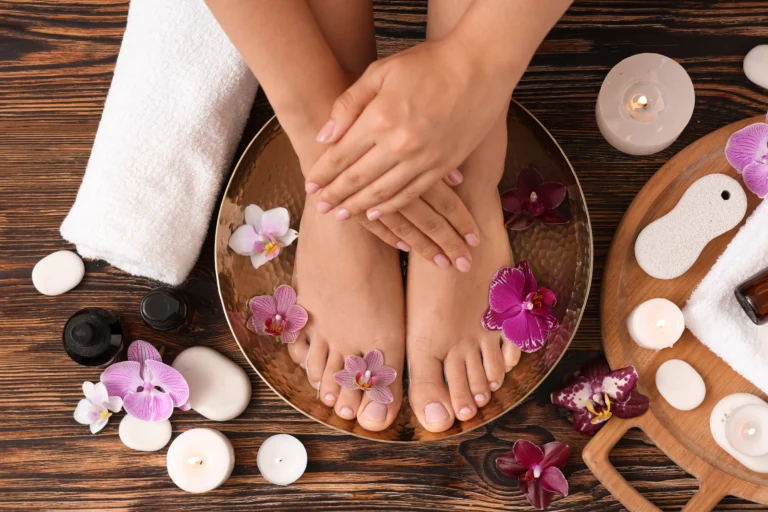
A pedicure includes a foot soak, toenail care, exfoliation and heel work, a foot massage and optional polish.
How long does a manicure and pedicure take?
A manicure usually takes 30–45 minutes, and a pedicure takes 45–60 minutes.
A file and polish is quicker, and luxury treatments with a mask and longer massage take more time.
Do pedicures hurt?
No. A manicure or pedicure shouldn’t hurt.
Cuticle care and heel work should feel like light pressure. If anything stings, tell your nail technician straight away.
What should you do after a manicure and pedicure?
After a manicure and pedicure, be gentle with fresh regular polish until it hardens, then keep your nails and cuticles moisturised.
Straight after your appointment:
- Wear open-toed shoes or sandals home after a pedicure
- Avoid knocking or pressing your nails until regular polish has hardened
Ongoing care:
- Apply cuticle oil and hand or foot cream every day
- Wear gloves for dishes, cleaning and gardening
- Moisturise your nails after removing polish, as most removers dry them out
- Don’t pick or peel gel polish; have it soaked off instead
A gentle foot scrub between appointments keeps your heels soft, and for the rest of your body, it helps to exfoliate according to skin type.
How long does a manicure and pedicure last?
A manicure lasts about 7 days with regular polish, while gel polish typically lasts 10–14 days, but can last up to 3 weeks depending on your lifestyle.
A pedicure usually lasts longer than a manicure, because toenails grow more slowly than fingernails.
How long it lasts depends on:
- Your choice of regular or gel polish
- How fast your nails grow
- How often your hands are in water
- Your aftercare
How can you make a manicure last longer?
Wear gloves for chores, apply cuticle oil daily, and add a fresh top coat to regular polish every few days.
How often should you get a manicure and pedicure?
You should get a manicure every 2–3 weeks and a pedicure every 4–6 weeks, because toenails grow more slowly than fingernails.
With gel polish, rebook once you can see a gap between your cuticle and the polish where your nail has grown out, and have the old gel soaked off before your next set. Many people book a pedicure monthly in sandal season, when their feet are on show.
Further Questions About Manicures and Pedicures
What’s the difference between a regular pedicure and a spa pedicure?
A regular pedicure covers the essentials of nail and foot care, while a spa pedicure adds extra steps such as a longer soak, a scrub, a hydrating mask and a longer massage.
| Regular pedicure | Spa pedicure | |
| What’s included | Soak, nail shaping, cuticle care, polish | Adds a scrub, heel work, a hydrating mask and a longer massage |
| The feel | A quick tidy-up | A pampering treatment |
| Best for | Neat toes between treatments | Dry feet, or time to unwind |
Consider a spa pedicure if your feet are dry or you want time to unwind. It also fits easily alongside other day spa treatments, such as a massage or facial, in one visit.
What’s the difference between gel polish and regular polish?
The difference between a gel manicure and regular polish is that gel polish is cured under a lamp and typically lasts 10–14 days, while regular polish air-dries and lasts about a week.
| Regular polish | Gel polish | |
| How it sets | Air-dries | Cured under a UV or LED lamp |
| Drying time | Takes time to harden fully | Dry when you leave |
| How long it lasts | About 7 days | Typically 10–14 days, up to 3 weeks |
| Removal | Nail polish remover, at home | Soaked off by a professional |
| Best for | Changing colours often | Long-lasting, chip-resistant colour |
Is Shellac the same as gel polish?
Yes. Shellac is CND’s brand of gel polish, and it’s cured under a lamp in the same way.
Should you cut your cuticles?
Yes. Cuticles can be cut as part of a professional manicure or pedicure, where your nail technician softens them, pushes them back and trims the excess.
Between appointments, push your cuticles back gently after a shower and keep them soft with cuticle oil.
Should you shave before a pedicure?
No. Shave after your pedicure, not before. Dermatologists advise waiting at least 24 hours after shaving before a pedicure, because a small nick from your razor could let in an infection.
How long after a pedicure can you wear shoes?
With gel polish, you can wear closed shoes straight away, because the polish is cured before you leave. With regular polish, wear open-toed shoes home and wait until the polish has hardened before putting on socks or closed shoes.
Do pedicures help ingrown toenails?
Shaping toenails straight across, rather than cutting into the corners, helps prevent ingrown nails. An ingrown toenail that’s already painful or infected needs a doctor or podiatrist, not a pedicure.
Can you get a pedicure if you have nail fungus?
No. You shouldn’t get a pedicure if you have nail fungus, a wart or a skin infection on your feet.
A nail technician should refuse service if infection is suspected and advise you to see a health professional, according to Toronto Public Health. Nail technicians don’t treat nail fungus, so see your doctor or a podiatrist first, and book once it has cleared.
Can you get a pedicure with a cut or blister?
Wait until it has healed, as broken skin is an easy way in for infection.
Can you get a pedicure if you have diabetes?
People with diabetes should check with their doctor or podiatrist before booking a pedicure. With numbness, poor circulation, cuts or ulcers on your feet, a podiatrist is the safer choice.
If you do book a pedicure, tell your nail technician you have diabetes. At home, don’t try to remove hard skin or corns yourself, as Healthify NZ advises, and see your doctor or podiatrist straight away about any cut or break in the skin of your feet.
Can a pedicure help cracked heels?
Yes. A pedicure can help soften dry, cracked heels with exfoliation, a heel buff and a rich moisturising mask.
For thicker calluses, a heel peel with AHAs and BHAs speeds up the removal of dead skin and soothes very dry heels. Deep, painful or bleeding cracks need a doctor or podiatrist.
Can men get a manicure and pedicure?
Yes. Men book manicures and pedicures too, often a tidy and buff with no polish.
For other grooming, such as chest or back hair, there are several options for hair removal for men.
Can you get a manicure and pedicure before or after other treatments?
Yes, but book your manicure and pedicure before a spray tan, and shave your legs after a pedicure rather than before.
- Spray tan: have your nails done before your spray tan, as soaking and exfoliating would fade the colour on your hands and feet.
- Waxing and shaving: shave after your pedicure, not in the 24 hours before, and ask the salon about the best order if you’re also booking waxing.
How much does a manicure and pedicure cost?
A professional manicure or pedicure in New Zealand typically costs $50–$130, depending on the treatment.
Typical price range includes:
- File and polish: $50, or $100 for fingers and toes
- Mini manicure or pedicure: $80
- Luxury manicure or pedicure: $130
- Gel (Shellac) polish: $15 extra
- French polish: $10 extra
- Heel peel or nourishing keratin treatment: $25 extra
View manicure and pedicure options and pricing.
Where can I get a manicure and pedicure in Christchurch?
Looking for manicures and pedicures in Christchurch? At Lovoir Beauty Salon & Day Spa, our nail technicians offer everything from a quick file and polish to luxury manicures and pedicures in a private spa room, finished with regular or gel polish.
Manicures and pedicures are available at our Avonhead beauty salon. Book your manicure or pedicure to get started.